Welcome to Our Blog

Thank you for sharing in our journey of building and sailing a Fusion Catamaran! We are so excited to be able to chronicle our adventure for family, boat and land friends, and supporters, from the initial decision to our cruising life "down island". Please post your comments, questions, and cautionary tales-we love to hear from you!


Tuesday, May 22, 2012

From Prep to Stage I

In the weeks since the last post, our build has come quite a long ways, and we have quickly completed the Prep stage and entered Stage I.  By the end of the first stage, the exterior of the boat, and most of the component pieces will be assembled into a fairly complete shell.  Of course, like many things in life, there is far more on the inside than meets the eye on the outside, and the following four stages will concentrate on the interior, and systems, such as plumbing, electrical, rigging, engines, etc.

During Andrew's visit, all of the shipped pieces were checked to make sure there were no faulty manufacturing issues, and that all were accounted for.  Then the assembly began.  One of the first pieces to be put together were the mini keels on the bottom of the hulls, which makes perfect sense, if you think of building from the bottom up! 


Here the plug for the mini keel was first ground and sanded smooth, as shown on the right hull.  The mini keel shell was then carefully fitted over top of it, with the edges carefully trimmed, and fiberglassed into place.  We see the completed assembly on the left hull.

Once these dried, the hulls were then flipped over and lifted into the jig, to become the first part of our boat.  Here, Andrew watches anxiously as the first hull is lowered into place.


Next, looking from the front of the vessel-to-be, we can see the large champfer panels fitted on each side and the bridgedeck that joins them in place across the front.  The seams were sanded and epoxied into place with small wooden tabs (squares) holding the seam together, sort of like band aids, until it completely dried.
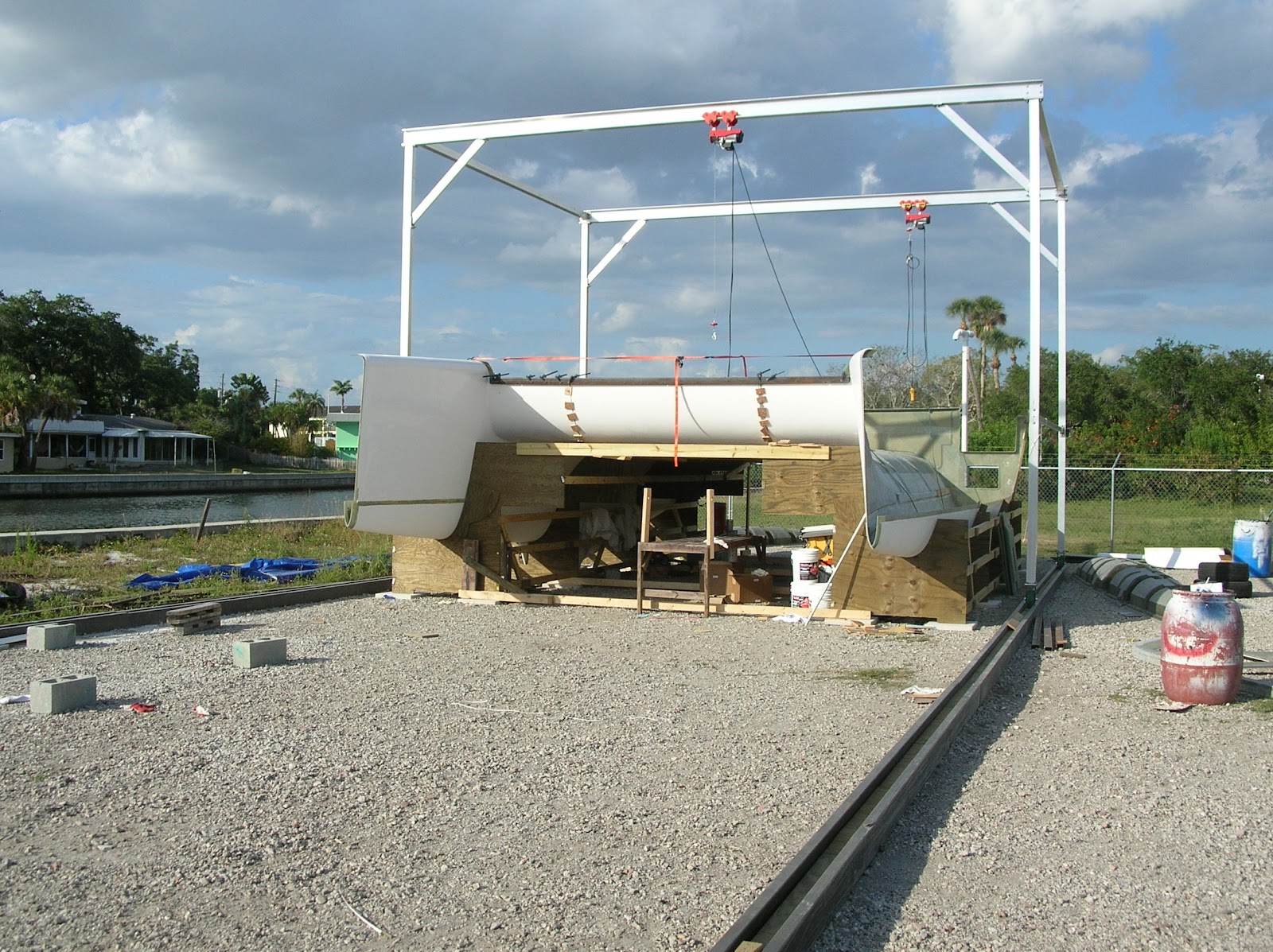


Going around to the rear of the boat, we can see a similar process with the two sugar scoops and the stern bulkhead forming the stern of the boat. 


Fitting more of the major pieces into place, we can now see almost a complete skeleton, and I am already imagining stepping out the door from the salon to the cockpit, holding an umbrella drink!


Next the crew moved to the underside of the front and back, fitting the bulkheads that will support the stairs, cockpit, and salon entrance:


These steps, while they look very impressive, are really just all about initial fitting and measuring.  We watched this progression excitedly via our remote camera, and then one day, the skeleton was dismantled and it appeared as if we were back to square one! But once the rough fitting had been completed, each piece had to be separately, carefully ground and sanded, with the edges trimmed to fit together exactly, and then glued into place.


Each seam of every piece is glued, and then a special unidirectional fiberglass mat is epoxied in several overlapping layers on the seams to strengthen them.  The layers start large and then get smaller with each subsequent covering, for maximum strength and bonding.  This special mat is something that is not commonly used here in the US, and had to be ordered specially, but it's use was highly recommended by Fusion.


The team worked together in a well-rehearsed rhythm; above Jake pays close attention to the mix of resin and hardener in the glue, before handing it off to Paul, who was doing the application.  This is a sensitive job, because too much hardener will cause the glue will dry before it's smoothed into place, and not enough means it will not dry properly.  It's also a really messy job, and by the end of the day, everyone was itchy because of the fiberglass. 


Here you can see the tedious process of sanding each individual piece to fit the ones next to it, and trimming the edges so it's completely ready for the bonding process.  This is where the team's attention to detail and their patience in getting each edge just right will pay off with a beautiful product in the end-strong and well-fit.  I think of my efforts at painting or wallpapering, which I love the end result of, but the endless hours of preparation needed drive me crazy!! 


Here you can see the rear beam (one half is an exterior finish and the other is unfinished, an interior part), ready for bonding and glassing.  It's a lot like playing with giant Legos or a jigsaw puzzle, but these preparation steps are really what separate the amateurs from the professionals, and it makes a world of difference in the quality of the vessel in the end.


Here we see up close the (messy!) process of epoxying the fiberglass into place, as additional drainpipes are glued onto the engine hatches, to improve drainage from these compartments.  This step is one of several that were not "in the build book", but were recommended by Andrew as a design improvement over the original build documents.  This was not the only time we were glad we bought kit # 71 and not kit # 2, since over time, Fusion has improved on the initial concept in several areas. 


This important piece is the compression bulkhead that will support the full weight of the mast.  A fitted piece of (very heavy) mahogany on either side of the joint, will reinforce and spread the full weight load of the mast.


This is the only piece of real wood in the whole structure, and when Lari first spotted it, she thought she was getting a beautiful mahogany tabletop!

Once the gorgeous wood is sealed and glassed over, it's hard to tell it's even there, but it will be silently supporting us as we take the boat to sea. 

After only three weeks, the team is able to triumphantly announce, "The first container is empty!"  Only one more to go :)


Our team has worked very hard to get to this point-Thanks for a job being very well done!

Jake, Paul, Rian, and Andrew!
Look for more progress in our next posts, as the exterior gets completed, and we move to the interior stages.  In the meantime, enjoy the summertime!


Sunday, April 29, 2012

Let the Adventure Begin!

The past few weeks have been very exciting for us, as events are unfolding now in rapid order.  Our two containers arrived right on time after being trucked from the Port of Miami to Sarasota, and are safely stored at the Yacht Center Sarasota.  Once we made sure all of the parts were present and accounted for, preparations began for beginning of the assembly as well as for the arrival of Andrew Pounder of PrimeFusion.  Andrew is a Fusion design specialist who has not only built his own Fusion SailCat, but has also supervised and watched as the design has grown and improved since its inception.  He is also the person who will certify Mondo Marine as an official Fusion Agent here in the US, making it possible for the future of this multihull design to gain acceptance in the American market.  Andrew has been emailing Rian with directions and specifications for months, and now we finally get to see how it will all come together!


But in between receiving the containers and Andrew's arrival, we attended the Suncoast Boat Show in Sarasota, with Mondo Marine.  Although the weather was just short of a gale, the booth attracted lots of attention, and some publicity as well.  Because this was a local boat show, it will drum up some immediate business for Mondo Marine in the area of boat repair, but also start to spread the word about Fusions and their unique appeal.  The typical purchaser of a Fusion Cat usually takes 2-3 years of shopping, looking, and consideration before settling on a Fusion build, so it is important to start luring potential customers early on.  Boat shows are probably one of the very best ways to bring boat seekers together with what's new on the market, since it is one-stop shopping where one can compare many different models.  Of course, we don't yet have an actual boat for folks to touch and feel, but it's never too early to start the ball rolling.


Just after the show closed, we held our unveiling party, to show interested people how the containers were packed, and share the story behind our choices.  We had a light turnout, but several of our friends and family were able to come by, as well as some interested folks from the area.  We do plan to hold additional gatherings at various stages of the build, to give folks a chance to see the progress and the process. 


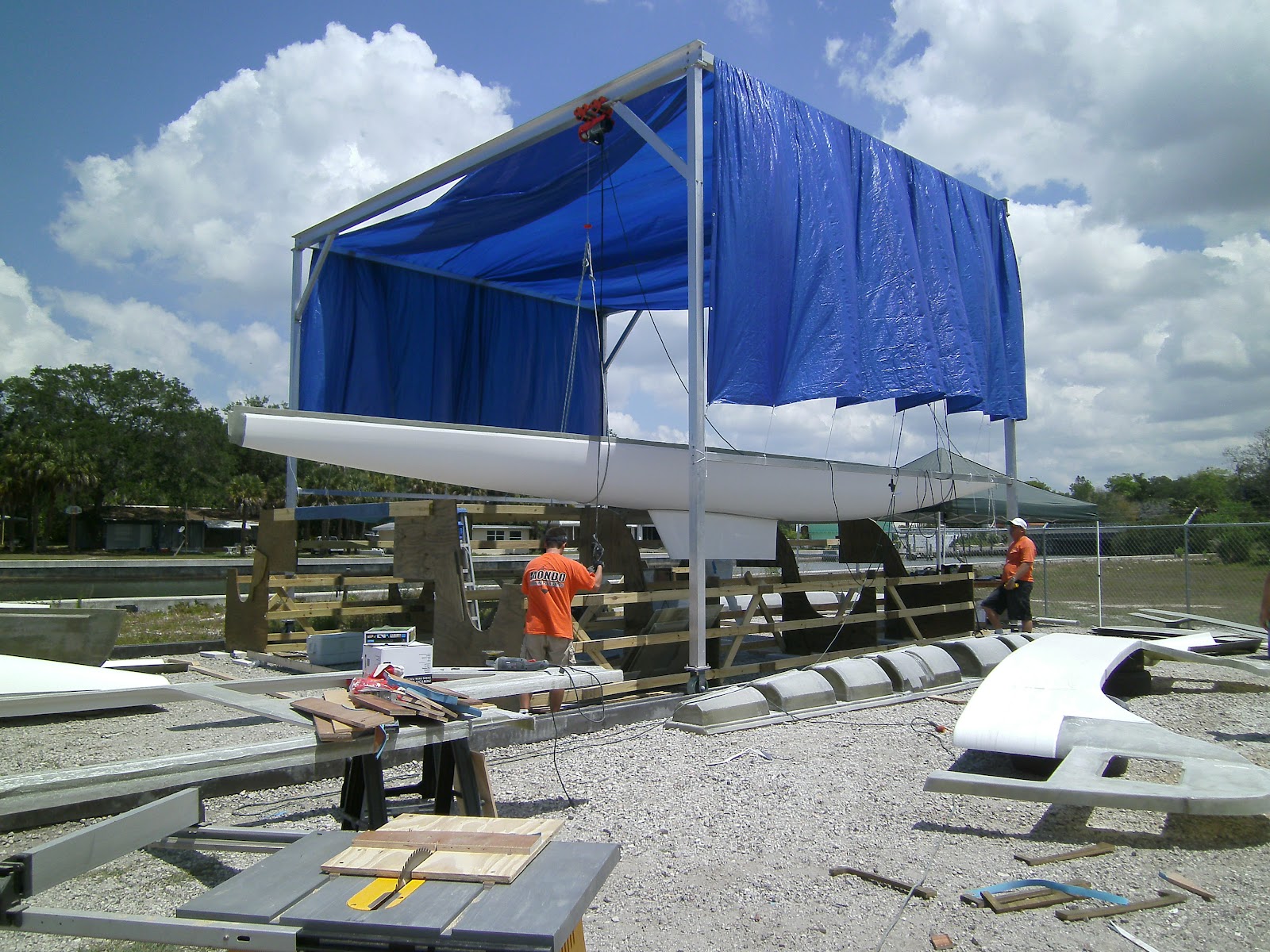
Once the weekend of the show and the unveiling had passed, work quickly began on two important pieces of equipment: the jig, and the gantry crane.  The jig, the wooden structure shown below, is basically a level, contoured cradle/mold for the pieces of the boat as they are fused together, which holds everything together until it becomes a stable structure that can stand on its own.


The gantry crane surrounding the jig is a large aluminum structure which can roll to and from the jig, and helps to pick up and then gently lower individual pieces of the boat into place.  The pieces themselves are (relatively) lightweight, and advertised to be able to be lifted and placed manually, but the mechanised gantry crane does this precisely with a minimum about of effort and a maximum amount of control.  This crane is also made to be disassembled and stored, so it will be able to be used later for future projects. 

In the meantime however, when it isn't busy rolling things into place, covering it with a tarp makes a perfect protection from the Florida sun and rain, under which to work.  It had been our intention to purchase a temporary building for this phase of the project, but the local zoning laws made even a temporary structure impossible.  So, the gantry crane will double as our shelter until the pieces come together to be the shell of the boat.  That stage will probably take somewhere between 6 and 10 weeks to reach.


As Rian and his crew were busily preparing the jig, the gantry crane, and some initial pieces, Andrew Pounder of PrimeFusion, and his wife Cheryn travelled from Australia to Sarasota, arriving on Friday, April 29th.  After a tiring 30+ hour travel by air to Miami, it was an additional 4-hour car trip across the state to the West Coast.  But along the way we introduced them to such American staples as 7-Eleven and Denny's, as we escorted them across Alligator Alley.  After an inspection of the preparation, we took the whole crew out for a celebratory dinner at Ocean's Harvest Restaurant, which we highly recommend as a terrific way to sample local seafood at its very freshest and creative!


The next day, work began in earnest, as the jig was first reinforced, and then carefully levelled, before the first pieces of the boat, the hulls, were lowered in.  This step is critical to the final outcome of the boat, ensuring that it will be level and balanced, and that the rest of the pieces will fit into place properly.  A small discrepancy at this point could lead to wide gaps (voids) in later pieces fitting together, so the patience and attention to detail of Rian and his crew now will pay off in spades when later stages are built on top of this perfect foundation. 


Meanwhile Dennis (and Abby the resident boatyard cat!) were busy installing a remote camera feed so we can log in and watch the progress over the Internet:


In the coming weeks, we will be posting with more of the details and decisions as our two containers come together to become a BOAT.  It is going to be an amazing adventure, undoubtedly with many twists and turns, but it is about the journey at least as much as the destination.  Let the adventure begin!


Friday, March 23, 2012

Fusion Travels the World

As I write, our Fusion kit is underway on the CSCL BRISBANE cargo ship, travelling slowly towards the US.  It turned out, after all options were compared, that it was least expensive to ship the containers to the port of Miami, and have it trucked to the yard in Sarasota.  

According to the Bill of Lading, the containers left Laem Chabang, Thailand on the "Uni-Aspire", on March 4th, and then met up with the ocean transport vessel, CSCL Brisbane, in Hong Kong, on March 8th.


Our cargo containers were two of probably hundreds (maybe thousands?) then transferred to the CSCL Brisbane, which then left Hong Kong on March 10th. 


How do we know all of this??  AIS!!

Cargo ships that are over 300 gross tons, and all passenger ships are required to have AIS (Automatic Identification System) transmit/receive technology.  This is a technology for unique ship identification, and tracks the ship's course, speed, and position in real-time, communicating this information to other ships with AIS receivers, and to AIS base stations. According to Wikipedia, AIS integrates a standardized VHF transceiver with a positioning system such as a GPS receiver, with other electronic navigation sensors, such as a gyrocompass or rate of turn indicator. Ships outside AIS radio range can be tracked with the Long Range Identification and Tracking (LRIT) system with less frequent transmission.

AIS is also a tool for cruisers (as we hope to be in the near future!) so we can see and be seen on the receivers of large ships during ocean passages.  We've heard of and seen videos of cruising boats being summarily run over by large shipping vessels, at night, during bad weather, or even in broad daylight.  Small cruising boats are very hard for a large ship to see, even if there is someone on the ship standing watch and looking out.  Frequently, there is no actual person on watch looking at the water, and the ships are guided pretty much by instrumentation and computers. 

As a personal anecdote, last year in October, as we were crossing the Gulf Stream from Miami to the Bahamas, for a week-long vacation on a chartered sailboat, we were very nearly trapped in the middle of a live-fire exercise drill by the US Navy, who did not realize we were in the immediate area .  Fortunately, we were listening on VHF channel 16, and heard their warning for the start of the drill.  We radioed back our position, and that, even under motor, we would be unable to clear the area in time, and they acknowledged and moved off to another place for their practice session.  I'm sure the watch officer got a dressing-down for that oversight, but from just that example in broad daylight, one can definitely see the value of AIS!

Here below is the Brisbane's published schedule, which is updated as it changes, and we see that it is due in to Miami on April 11th.  Of course, we plan to be over there, in our current boat, to see if we can get some live photos of its arrival, so we will keep everyone posted.


If you would like to track the Brisbane's progress yourself, here is the link to it on MarineTraffic.com:


They have some very cool real time maps of all the vessels they keep track of, along with last known positions, etc.  Since the underlying communication system, VHF have limitations on their range, the base stations don't always know where the ship is at this particular moment, if it is out of range.  I do wonder why they don't go to a satellite-based system, which could solve that issue, but I'm sure there are better minds than mine working on that (at least I hope so!)

We hope to see all of you in Sarasota for our unveiling on the 23rd of April.  I know it is a Monday, but what a great excuse to miss work!  If the date changes, we will send out a post and email, but that is the plan right now.  Hope to see you there!


Friday, February 3, 2012

SAVE THE DATE!

SAVE THE DATE!!
April 23rd, 2012
 Yacht Center Sarasota
The Unveiling of XYZZY

Yes, she's finally arriving!  In the months since the last post, we've been busily getting ready for the appearance of our kit, which will ship at the beginning of March, and after a long journey from the Thai manufacturing company, CMBI, arrive in Sarasota, Florida in April.  It will arrive in two 40' shipping containers, and then Rian and Mondo Marine can begin the build process. 

During the wait, we've had time to figure out how to insure the kit throughout the shipping process, once it leaves the hands of CMBI, during its 4-6 week transit.  We finalized the builder's risk insurance that will insure the parts and partially assembled vessel during the build process here in Florida.  And we've had to locate an international freight forwarder to help coordinate the two ends of the shipping process: packing, fumigating (yikes!), and loading in Thailand through to landing in Tampa, clearing customs, and being delivered to the yard in Sarasota.  Truly, I have visions of customs officials wearing pirate costumes holding the containers offshore for ransom because I've forgotten some small but critical detail!

So to keep from worrying too much while waiting, we're using the time to do two very important things:  choose and implement a project management system, as well as educate ourselves on various marine topics. 

From the beginning of the project, even as we interviewed builders, we knew that having some sort of way to manage the project and keep track of all the various threads would be integral to the success overall.  Most available project management software has grown out of the computer software development industry, and many programs that we looked at have things like built in version control, and bug tracking (and they aren't talking about the ones that are going to be fumigated!).  We discounted those that looked like they were designed to be used at Apple. One big priority was that all parties (us, Mondo Marine, the boat yard, the subcontractors) had to be able to have access at any time, from anywhere, to the project.  We had heard from several previous kit builders that it was very important to be ON SITE with the boat and builder, to keep things moving along.  We briefly toyed with the idea of relocating to the Sarasota area, but we really, REALLY like Coconut Grove, and didn't really want to move to the west coast (of Florida).  So, to help avoid weekly 8-hour round trip drives, we intended to choose a project management system that would be online in the "cloud", rather than installed on any single computer. 

Besides needing a web-based system, it was also important to have a system that would track To-Do lists, have a group project calendar with milestones and events, be able to organize emails from all parties into categories, and notify the participants when updates were posted.  Another important feature was to be able to upload, categorize, and store scanned documents, pictures, spreadsheets, and web links, so we can all collaborate on products we find, designs we like, contracts, schematics, drawings-the list is endless, really.  We needed a system that would also track all the purchases that will go into the boat: where it came from, when it was purchased, for how much, what the warranty is, and when the warranty period started and ended.  (The tracking of the purchased components will help us to determine the final value of the vessel, but also to develop a database of suppliers for spare parts.)  And lastly, we looked for a system that Mondo Marine could use to track their employees' and subcontractors' time on various aspects of the build. 

More than just fulfilling an obsessive need to document the project, managing the project through software is also a matter of putting together a schematic for future builds, and working to perfect the process.  From the beginning we have seen our venture as the first of many Fusions to come, and using the project management software will help us and Mondo Marine build a template for future clients. 

With all of these criteria in mind, we chose a product called BaseCamp.  It came with a free trial, and an easy-to-handle monthly fee after the trial expired.  It offers all the features we looked for, and lets us all "work" on the project whenever we have a few minutes.  We can email and post from within BaseCamp, so everyone sees the communications, and we can have a "campfire" and chat realtime, or work online together on a collaborative document, such as the spreadsheet of electrical specifications that Dennis and Rian are building.  Each can see the changes that the other is making, and everyone always sees the latest version of the document.  In the planning and preparation phase, this has already been extremely helpful, and we haven't even started the actual construction!

Another way we've been using the time prior to the arrival of our kit is to attend classes.  Yes!  We've gone back to school!  We chose a very special institution called Seven Seas University (http://www.sevenseasu.com/).  This is the educational branch of an organization called Seven Seas Cruising Association (SSCA) (http://www.ssca.org/) which provides various services and information to cruisers worldwide.  SSU students (the university) do all of their classes through online webinars that are offered in 1-2 hour sessions in the evenings.  Through SSU we have learned about weather: the flow of cold and warm fronts, how to tell the progression of storms, how to interpret barometric pressures, read various weather maps, and what websites would give us the best information about weather while cruising.  We've learned about how to sail in various kinds of heavy weather, and techniques for waiting out bad weather, should we be on a long passage.  We attended a session on wind and solar power, and another on marine air conditioning, and refrigeration.  Here is a short list of topics they offer:


 Safety at Sea      Electronics    Women's Issues    Diesel Engines   Electronics

Watermakers     Communications    Provisioning     Anchoring    Pets Aboard

Writing for the Boating Market    Alternative Energy    Sail Trim and Inventory

As you can see, the topics are very extensive, and pertinent to both building a boat and the cruising life.  They also have wonderful presentations about many of the best cruising destinations, and the easiest routes to get there, which are extremely inspiring, just in case we've lost sight of our end goal! 


We were first introduced to SSCA and SSU at the Miami Boat Show last year, and later attended a "GAM" (meeting) during the summer, where we listened to various speakers, and met fellow cruisers.  With few exceptions, we were the youngest people there, but it was great to meet and learn from others who have been cruising, full-time or part-time.  Every person there had a commitment to cruising; some had already made their dream happen, while others were still planning.  One couple touched us dramatically-Roger and Betty. Roger and Betty were easily in their mid-to-late seventies.  Roger's hands trembled uncontrollably at the table, while Betty was stick-thin, wrapped in many sweaters, despite it being mid-summer in South Florida, and looked as if a slight breeze would bowl her over.  Roger proudly pulled out a business card, and showed us a photo of his trawler (which is a power boat, not a sail boat).  He told us they would be going on their maiden voyage this year-to Tahiti!  Wonderful, we told him!  What a great plan!  Where was the boat moored now?  Still on blocks in his backyard, he told us; she still needs some work, but, by golly, we are going to do it this year!

Listening to Roger and Betty's plans made us both very sad and very inspired.  But most of all, it made us determined not to be looking back at our lives in twenty-five years, wishing we'd done this sooner.  of course, none of us never know what life has in store for us, and the picture can change in an instant-no one has to tell us that!.  But never let it be said that we didn't try and live the journey. 

We hope to see many of you at our XYZZY Arrival Event on April 23rd, at the Yacht Center Sarasota, to share the launch of our dream-you're all invited!  Let us know if you can come down, and we'll help you make arrangements.  We will be having local press, as well as folks from vendors, and hopefully some of the Fusion Team from Australia.  We know we never could have begun this adventure without the support of all of you and look forward to sharing the beginning of that realization with you all!

Days, precious days
Roll in and out like waves
I got boards to bend, I got planks to nail
I got charts to make, I got seas to sail

Sails are just like wings
The wind can make 'em sing
Songs of life, songs of hope
Songs to keep your dreams afloat
I'm gonna build me a boat
With these two hands
It'll be a fair curve
From a noble plan
Let the chips fall where they will
Cause I've got boats to build!
                                                        -Jimmy Buffett, License to Chill Album


Sunday, November 6, 2011

When is a Boat Not a Boat? Lessons Learned

Footsore and weary, we have returned from the boat show, laden with notebooks full of pamphlets, brochures and business cards for cool things we want on our boat.  We met tons of great people with great ideas and everyone was very enthusiastic about our project...once we explained it in the right way.  At the start of the show, we began our conversations with, "We are building a boat; it's a kit boat from Australia...being built in a yard" only to be met with smirks, giggles, raised eyebrows, "Oh, really?", and"Hmmm".  Clearly, our explanation lacked credulity.  After the fourth or fifth time that this happened, we grabbed our builders, Rian and Lari, and made them come with us.  Then we introduced our scheme this way: "We are having a custom sail cat built in a yard in Sarasota, and these are our builders..."  It is truly amazing how much more respect and interest this lead in commandeered for us!  The first introduction made us sound like we were constructing a large Lego set in the back of the house, while the second implied a serious venture, well thought out and funded.  First Lesson Learned.

One of the conundrums we had hoped to solve while visiting vendor booths was the issue of insurance. Of course, I knew we needed insurance on our boat, and our project, very much like a home, I assumed.  So I confidently approached the first marine insurance vendor's booth.  Using my refined explanation of what we are doing (see above) so as to be taken seriously, I approached the veteran insurance salesman who looked bored.  I figured he would be able to educate me a bit.  I asked about insurance costs. " No problem, what kind of vessel is it?" he asked.  " Well, it will be a Fusion 40 Sail Cat, but right now it's in two shipping containers, coming from Australia," I replied.  This response brought double frowns.  First, the Fusion 40 is not a well known manufacturer like, for instance, Sea Ray or Lagoon, so we'd given him no frame of reference.  Next , if it was in two shipping containers, it clearly wasn't a boat!  He kindly shook his head and replied, "No, come back when it floats.  Then we can sell you a policy."  I walked away, deep in thought.

The salesman's answer seemed to make some sense, but I felt it could not be the entire answer.  There was the time the containers would spend en route to the yard in Sarasota to consider, and also the two plus years it would spend being constructed at the yard.  Kim, the yard owner had already told me that their insurance would not cover the boat itself, and that we needed a separate policy. 

After several more inquiries, and many more frowns, the Progressive insurance salesman was finally able to explain the answer:  we needed a Builder's Risk insurance policy!  This would start out covering the initial investment in the kit, and would increase in value over time, as the kit slowly became a vessel.  Then, when it was launched, and under its own power, we could have it surveyed, and valued, and then purchase a regular marine insurance policy.  Finally, this made sense!  The salesman explained that his company does not write this insurance, but he took my contact information, and promised to have an associate contact me, and sure enough, two hours later, I had an application in my email.  So, Second Lesson Learned.  Thanks, Flo!


In discussing this information, and reviewing the insurance application, however, we hit another snag: how would we know what the boat was worth at any given time, in order to make the adjustments in the policy?  And this question tied in with another murky area: boat registration.  Every vessel is registered in a "home port", and then as it travels to other waters, needs to obtain cruising permits to stay for a specified length of time.  We had already contacted the Department of Motor Vehicles, which handles vessel registration in Florida, and discussed our plans with a very enthusiastic government worker.  But, he reiterated, just like the insurance vendor, that until our boat was a BOAT, it could not be registered.  And oh, by the way, at that time you will need to pay sales tax on the boat.  His definition of a boat was the same: it needed to be able to be launched and operate under it's own power.

OK, that's cool. But wait...Sales Tax???  Sure, when you buy a car, or other products, you pay sales tax.  But this sounded like double dipping: if we paid sales tax on most of components as the boat was built, why did we then have to pay sales tax again on the value of the finished product?  We next called the State Tax Department, where we talked with another (very enthusiastic) government worker who explained that we needed to keep very careful track of the cost of what was used to build the boat, along with any tax paid on those purchases.  Then, when the time came to declare  XYZZY a real boat, we would be able to complete a form, back it up with documentation, and only pay the difference.  In addition, in July of 2010, a law was passed that the maimum amount of tax on a boat (in Florida) was $18,000.00.  Wow!  They have either spent a lot of effort to train these state workers in people skills, or the folks that work for the State of Florida are just much nicer people than those who work in health care insurance-the folks I get to argue with every day in our business!  But they were very helpful, and we felt the puzzle was finally coming together.  Lesson Three Learned.

On the last day of the boat show, we revisited several booths, feeling confident that we had the answers to our questions.  Stopping by a booth that advertised Vessel Registration, we thought we'd just get a bit more clarification on all that we'd learned.  But no, the folks here had more wisdom to impart.  Turns out that you can incorporate your vessel, and that as a corporation, it is treated very differently that when it is owned by individuals.  Furthermore, Alice explained, you could incorporate outside of the US, like in the British Virgin Islands, or the Cayman Islands, and avoid the entire discussion of sales tax.  But, I wondered, what happens when we want to sail in US waters?  Simple, Alice explained, you purchased a cruising permit, and then you are allowed to stay in the US for a year, at which time, you had to leave, clear a foreign port, such as the Bahamas, and then return.  How bad could that be, we wondered?  Not really a hardship to have to spend time in the Bahamas once a year!  This sounded really interesting, and so we have more topics to research.  Lesson Four Learned: you're never done learning!


As we meet people, and put forth our questions and ideas, we are constantly surprised at how much we learn.  We wanted to include this information for our blog-readers, because it took a lot of effort to put this information all together, and we hope the next folks who decide to go down this road won't have to struggle quite so much.  It reminds me of when our daughter Jenn was trying to make the transition between local ballet lessons and pursuing a professional career in dance.  Every step, every turn was a myriad of unanswered questions, and many times it was like pulling teeth to get answers on what to do next.  It also reminds me of when we were new parents, with our first baby, and every situation, every discovery, every decision was uncharted territory.  Why, I remember wondering, didn't people warn you about these things?  Why weren't there required pre-childbirth counseling sessions by parents who had been there, done that, instead of baby showers with goofy games or Lamaze lessons on breathing? Turns out the birth process was the easy part! I suspected it was a conspiracy, because if the truth were really told, there might not be too many babies born at all!

But, like most difficult paths in life, both of those adventures were well worth the struggle, and I'm sure this one will be as well.  Where's the fun in doing something ordinary, living a cookie cutter life, of not taking "the road less travelled"?  Fifth Lesson Learned.

Am I a real boy?
              No, Pinocchio.
              To make Geppetto's wish come true will be entirely up to you.
              Up to me?
              Prove yourself brave, truthful, and unselfish,
              and someday you will be a real boy.

                                                                        -Pinocchio

PS-I did promise that I would post the most exciting thing we found at the show that has made it to our "Gotta Have It" list.  So, here it is, an electric, foldable bicycle! It is electric-assisted, so the motor engages when you start pedaling, and when you stop, you go into coast mode, and the motor disengages.  It folds up small and the battery recharges in 2-3 hours.  Just perfect for exploring!  Dennis would not let me take his picture, although he did a tour of the Convention Center!


Sunday, October 9, 2011

What We Can't live Without

Here we are in October already; time is really moving quickly!  At the end of this month will be the overwhelmingly large Fort Lauderdale Boat Show, where we will find lots of inspiration for outfitting our boat, XYZZY.  For those of you who are not familiar with the boat show schedule, the major player on the East Coast is usually the Annapolis Boat Show.  This show is SO large that it is actually held over two long weekends.  The Sail portion is centered around Columbus Day weekend, while the Power boats show off the weekend following that.   We have yet to attend this show, because it always conflicts, date-wise, with something.  (You know how, in the scheme of life, there are always certain dates which scheduled events always pile up around?  You can go weeks with nothing planned, and then all of a sudden there are five places you'd like to be, all on the same day!  Well, that's Columbus Day weekend for us, most years.) 

The next major boat show after Annapolis is at the end of October, in Fort Lauderdale, and while it does not split itself between sailboats and powerboats, it does attract a large number of vendors for both persuasions, with displays and booths for everything from generators to kitchen appliances. So, this will be our big chance to go "window shopping", and compare choices on all sorts of items our boat will require. 

When we planned this 5-day marathon last month, Lari advised us start our "List of What We Cannot Live Without".  You see, living aboard a boat, whether permanently or just for long cruising periods, is a delicate balance of comfort & convenience vs. weight and performance.  In other words, one can travel light and lean, living in survival mode, and improve the boat's speed and performance, or one can load up on all the conveniences of life, and weigh the boat down so much that it cannot get out of its own way!  Of course, a boat does not have the same amount of living space to start with, that most of us do, with a house, yard, and garage. (Kris & Leah, in their Manhattan apartment, might come close, though!)  While catamarans do have more space and storage than traditional monohull sailboats, space is still a limiting factor.  Most cruisers settle for some compromise between survivalist and luxury; thus we need a list to help pare down what goes aboard.

There is a philosophical component to putting together such a list, which quickly became apparent as we researched and contemplated our own.  Among the sailing community there is deep division between the ends of this spectrum.  Many sailors eschew all but the bare minimum and take pride in doing without all the conveniences of modern life.  Others cannot bear to be separated from their full array of creature comforts, TVs, and electronic accoutrements.  Most people, ourselves included, go cruising to try and eliminate the clutter of life, get "back to basics" and enjoy the simple pleasures of nature, family, and traveling.  We used to go camping for the same reasons, when our kids were little. Unfortunately, a computer and Internet are staples of keeping our business running, and these days, hand pumping a toilet and sleeping in 100% humidity is somehow no longer appealing.  I'm beyond the point in life where I feel I have something to prove by suffering through it. (For those of you who knew me back when I was a snotty, rebellious teenager, yes, I have changed!)   So, compromise is again the word of the day. 

The first things on our "Must Have" list include whatever the latest technology is to maintain Internet connectivity.  We don't see ourselves not working (different than retiring!) any time soon, so this is at the top of the list.  Currently when we charter, we always bring along our cell phone extender which gets mounted to the top of the mast, and increases our cell phone (and thus Internet) range substantially.  Another category close to the top is marine electronics.  While we don't want to become the type of sailors that can't sense how to set the sails without checking the console, or tell that the water is too shallow by its color, we do appreciate the advances in technology for what it brings to safety while sailing. 

Moving on to items in the comfort category, we have a watermaker on our list, which we feel is necessary for an adequate water supply.  A watermaker will allow us to create fresh water from the frequent showers and rainfall of the tropics, and supplement what we can carry in tanks.  When we cruise, we don't usually go into severe water conservation mode, as many cruisers do.  Obviously, we don't take 30 minute showers, and I have no problem, when in the clean, clear waters of the Caribbean,  using biodegradable soap and shampoo to wash up in the ocean, and then rinsing in fresh water.  But I am NOT going to bed coated with sticky salt! 

This discussion leads right into the inclusion of a mini clothes washer/dryer on our list.  Many people we've spoken to have poo-pooed the idea of having a clothes washer and dryer aboard.  Their solution?  Take extra clothes, towels, and suits, and just do masses of laundry whenever you come to a port.  This is fine if you are cruising for 1 or 2 weeks, but not realistic if you are going for a month or more.  It starts to become a trade off of space (for dirty laundry and extra clothes) vs. the convenience/expense.  We're going for the washer/dryer!  Remember,no judging!  There's no right and wrong answer here, just compromise. 

Electric vs. manual heads (on board boats, toilets are called heads) to me is a no-brainer.  Why would I want to spend many minutes in a hot, stuffy bathroom, pumping out a toilet, when I can just press a button?  This needs very little discussion, in my mind.  We visited a friend's boat once, which had three heads.  One (his, of course) was electric.  The other two were manual.  Guess which two were clogged?  Yep, the manual ones :).  OK, I was judging just a bit there...

Moving on to recreation, work, and sentimentality, we can score points because books and photos are easily stored electronically, or better yet in "the cloud".  (Clouds take up very little room on a boat!)  And with NetFlix and Amazon, our "TV" can be combined with a computer screen, which doubles as a console for the marine electronics.  Our client files and documents are securely stored on a hosted computer somewhere on land (or in a "cloud"), which I can easily access via my iPad or SmartPhone.  So no filing cabinets or bookshelves needed on board.  I'm still trying to talk Comcast into hosting our DVR, so I can "log in" and watch my recorded TV; we're working on it.

And so it goes.  The idea of a "Must Have" or "Can't Do Without" list is really something worth considering.  It is a very cathartic experience to whittle down one's life to an acceptable minimum designed to fit comfortably into a small space.  Even if you are not actually moving onto a boat yourself, there is a lot to be gained from such a mental exercise-try it and email us what's at the very top and bottom of your lists!  We'll publish some of the best in the next post. 

“Twenty years from now you will be more disappointed by the things that you didn't do than by the ones you did do. So throw off the bowlines. Sail away from the safe harbor. Catch the trade winds in your sails.. 
 Explore. Dream. Discover.” 
- Mark Twain

Thursday, September 8, 2011

The Name of A Dream

Several weeks ago we made our first trip (of many to come!) to visit Rian and Larissa ("Lari") in Sarasota.  We planned to review some of our initial design thoughts, visit the boatyard where our project would be built, and talk over the stages of work.  There we met with Kim Lindsey of Sarasota Yacht Center, who impressed us immediately as an extremely dynamic and competent operations manager.  Her yard, like many businesses on the west coast of Florida, has suffered some setbacks of late, due to the economic recession, and unrealized business deals.


But rather than dwelling on the past, she is enthusiastically planning for the future, and showed us the changes to the yard, the access road, and the entranceway they would be making to accomodate the equipment that would be needed to deliver our kit, and to eventually launch it as a finished boat, the first Fusion of many more planned to come. 


When we first considered the Fusion 40, we had trouble finding anyone that could tell us more about the concept, but we felt strongly from the beginning that the Fusion 40 was a perfect fit, not only for us, but also for the North American market.  And it is clear to us that the rest of our team, Kim with Sarasota Yacht Center, and Rian and Lari from MondoMarine, share a similar vision. 

That weekend, we talked and planned for over ten hours, touching on topics large and small, from diesel vs. electric engines to where the microwave would be located in the galley.  But in a quiet moment, while we were all mulling over the enormity of the decisions ahead, the most important question popped up: "What will the name of the boat be?"  And sheepishly, we had to admit, we had not decided! 

On the drive back home to Miami, this question became the focus of our discussion.  For years we had kept a running list, first mentally, and more recently on paper, of possible boat names.  Most related back to a song or a fond memory, but as we considered them now, they seemed trite and predictable.  Names you might see in any mooring field: Journey, Evergreen, Cool Change, Wanderlust headed the list. We did come up with Dennis (the Menace) and The Kobayashi Maru as some of the more original candidates, but nothing felt just perfect.  (Actually, we were afraid that Kobayashi Maru might mean something nasty in an Asian language that we were unaware of!)

Then suddenly, out of the contemplative silence, Dennis said, "XYZZY-that's what we should call it!" XYZZY?  What was that?  A mysterious password, my husband explained, that had first been coined in an early computer game played on the original PC.  What was the game called?  Adventure! Hmmm...I was not convinced, although it certainly was unique.  I Googled it and came up with this from UrbanDictionary.com:

The quintessential magic word, originally from the "ADVENT" text-adventure game.
The word XYZZY would teleport the player when spoken in the right location.
Wow!  This really spoke to us!  A magic word that would transport one to a special place?  Well, that is what our Fusion dream was all about!  Drawing on the beginnings of our techy backgrounds, and alluding to the inherent escapsim in our Adventure, it seemed perfect.  True, there would need to be explanations of the name (we're thinking of T-shirts and pamphlets with the definition) and the pronunciation (just say the letters, don't try to get complicated...), but it was certainly neither trite nor predicable. 
And so, our Fusion is hereby christened "XYZZY".  And the dinghy will, of course, be named "plugh" (pronounced "plew")...you are on your own to figure that one out!

Sunday, August 21, 2011

Our Partners

So after our first post, most likely all of you are thinking, "What has happened to Debi & Dennis?  They've always been such level-headed people; now they've really gone off the deep end! Can you imagine trying to build a boat yourself?"  And admittedly, we did toy with the idea of tackling our Fusion 40 on our own...for a couple of months.  But we ran into tons of basic, logistical issues right away, such as where we would work on something so large, how we would find people to do the pieces we didn't have the expertise to do ourselves (most), and if we ever completed it, how would we launch it?  Fusion Cats (http://www.fusioncats.com/) has a wonderful website showing many ambitious boat builders plowing down trees to get their catamaran to the water.  While that would certainly not be our experience in Florida, land near the waterfront is pretty expensive, and we did not want a finished product that screamed "HOMEMADE!" 


That settled, we proceeded to look for a builder to help us out.  Jim Gard, of Fusion Australia, had some suggestions, and as we wandered through the Miami Boat show this past February, we tackled every vendor we could during the three days we attended.  We explained our endeavor, and asked them all if they knew of any sailboat builder they felt would be up to the task.  Trying to limit our choices to somewhere in the South Florida area, we eventually came up with a short list of four builders.

The next step was to go visit each of them, and discuss our project.  So we made contact appointments and, armed with a booklet of Fusion documentation we'd assembled, set off on a roadtrip down to the Keys, and up the west coast of Forida, to Sarasota and Tampa.  Our crtieria were fairly straightforward: we wanted a builder who'd had previous experience with this type of project, a location where the build could take place, understood catamarans and the compromises between comfort and performance that we were seeking, could accomodate a schedule that might well stretch over several years, and above all seemed responsible and honest.  A lot to ask, for sure! 

During our search, we met a number of wonderful folks, and also got to visit the only two existing Fusion 40s that are on the east cost of the US.  We connected with Don Walton on a rainy, cold day in March down in Marathon, and he spent several hours patiently showing off "Boomerang", demonstrating all of the cool, custom ideas he had built into her.  Then later in the spring, we met up with a potential builder named Rian Mondrian in Sarasota, and he showed us Jim Noland's boat, "Restless".  Along the way we also heard many horror stories of stalled projects, builders who absconded with their clients' money, yards that had gone out of business with the boats held for ransom! Many days later we returned to Miami, now convinced we wanted to have a Fusion built, but still unsure of  who are build partner would be. Clearly whoever we partnered with could greatly affect the success of our dream.

Weighing the pros and cons of the builders we'd met, we whittled our choices down to just two, and they seemed very evenly matched.  How would we choose?! The final decision would be made after we reviewed their responses to a "Request for Proposal" we sent to both companies (it works in the computer industry, so why not?).  Our proposal request was two pages of indepth questions on the companies, their philosophies, and their build procedures.  We wanted to make sure we could compare apples to apples on all of the important points.  (If anyone reading this is interested in the specific proposal, email us and we will happily send you a copy.)  We gave the two prospects a deadline of the end of May, a little over two months away. 

In the end, we chose Rian and Larissa Mondrian, of Mondomarine, in Sarasota, Florida.  They took our proposal request very seriously, and clearly put a lot of time and thought into their response.  They have been enthusiastic supporters of the project from the start and we feel very confident in our choice.  In addition to taking on our individual project, they are now in deep discussions with Fusion Australia about launching Fusions into the US market, an endeavor we look forward to spearheading with them.  Thank you, Rian and Larissa, for helping our dream come alive!


"Ships are the nearest things to dreams that hands have ever made, for somewhere deep in their oaken hearts the soul of a song is laid."
Robert N. Rose

Sunday, August 14, 2011

The First Steps

So it is official! After years of roaming boat shows up and down the coast, dreaming of what "our" boat would be like, and chartering with our family and friends all through the Caribbean, we have decided to build our own catamaran! 

In the end, the decision, like all good outcomes, was really the only choice that made sense.  All of the boats we've chartered have always had many good points and then some bad; certain comforts that would make us exclaim, "What a great idea!", followed closely by other discoveries that  elicited a disbelieving "Really!?? Are you kidding?"  Every voyage caused us to add items to our list of what we did and didn't like on that particular boat.  Eventually we realized that no single design we'd met so far would be perfect for us, and that even refinishing a used catamaran would limit us in certain ways due to the inherent design of the craft. 

Buying a new boat was financially out of the question for us, and even had it not been, we would still have to live within the scope of a narrow design, with only limited ability to customize our dream.  It was then that we first looked at the Fusion 40 solution, and right from the beginning, it fit us perfectly.

So, on July 1st of this year, we sent in our initial deposit, which placed our order into the queue for production, and we are expecting our delivery sometime around April of 2012.  But in between now and then, we have tons of decisions to make and plans to put together.  As we plunge ahead into our Fusion Adventure, we want to chronicle the process for you: our family, friends, and other sailing enthusiasts that might consider this the solution to finding their heart's desire.  You can follow our progress, lend your help and comments, ask questions, and vicariously sail along with us on our journey. 

"It isn't that life ashore is distasteful to me. But life at sea is better."
-Sir Francis Drake